When most people sit down to update their resume, they make the same mistake: they list out every job title, every duty, every bullet point. It’s neat, it’s organized, but it’s not memorable.
Here’s the truth: your career is more than a list of jobs. It’s a story. And when you learn to tell that story clearly, you stand out to employers, gain confidence in interviews, and make better decisions about your next move.

Why Your Career Story Matters
Hiring managers aren’t just scanning for titles; they’re looking for patterns. They want to know who you are as a professional, what you consistently bring to the table, and where you’re headed next.
A well-told career story does three things:
- Connects the dots across roles and industries.
- Highlights your unique strengths in a way bullet points can’t.
- Points forward to the job you want now, not just the ones you’ve had.
But here’s another benefit: your career story doesn’t just market you; it guides you. When you’re clear on your narrative, you can make smarter choices about which opportunities to pursue. Instead of applying to every job that looks “interesting” or sort of fits your background, you can pause and ask:
- Does this role fit into my story?
- Does it move me closer to where I want to go?
Framing your career this way gives you a filter. You evaluate a role not only on salary or title, but on whether it aligns with your bigger picture. In other words, your story becomes a checklist. If the role doesn’t check enough boxes, you know it’s not worth your energy.
The Building Blocks of a Career Story
Think of your career story like a novel. What are the recurring themes? Where are the big turning points? Who’s the main character (hint: it’s you)?
Here’s what to include:
- Theme / Throughline – What ties everything together? Maybe you’ve always been the problem-solver, the relationship-builder, or the person who turns chaos into structure.
- Pivots – Don’t hide career changes or transitions. Explain them as intentional choices that brought you skills and perspective.
- Wins – Go beyond duties. Instead of “responsible for client communications,” say, “built long-term client relationships that increased renewals by 30%.”
- Future Direction – A great story ends by setting up what comes next. Show how your past has prepared you for the role you’re seeking today.
How to Write Your Story
Writing your career story starts with reflection. Before you can explain your path to someone else, you need to understand it yourself. Think back on each role you’ve held and ask what drew you to it, what skills you developed, and what impact you made. This step alone often reveals themes you may not have noticed before: patterns in the way you solve problems, the environments where you thrive, or the kinds of challenges you naturally gravitate toward.
Once you’ve done that groundwork, it’s time to connect the dots. Look across your experiences and identify the thread that ties them together. Maybe it’s your ability to build strong relationships, your knack for stabilizing messy systems, or your drive to improve processes wherever you go. Whatever it is, that throughline becomes the backbone of your story.
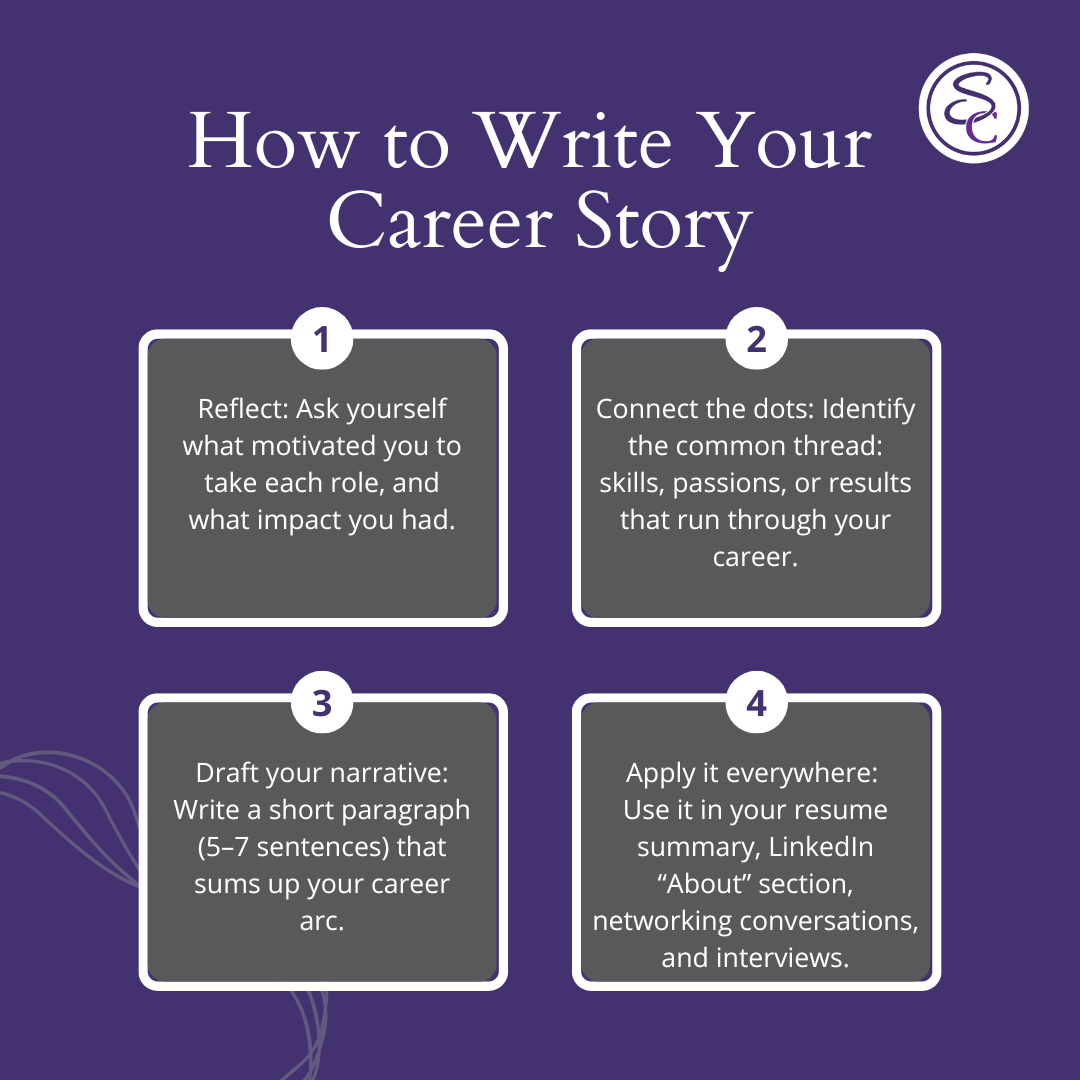
From there, draft a short narrative—just a few sentences—that summarizes your career arc. This isn’t a full autobiography; it’s a clear, compelling snapshot of who you are as a professional and the value you consistently bring. Aim for a paragraph (five to seven sentences) that explains where you’ve been, what you’ve learned, and how those experiences position you for what you want next.
Once you have that narrative, put it to work. Your career story belongs everywhere: in your resume summary, your LinkedIn “About” section, your networking introductions, and especially your interview answers. When your story is clear, consistent, and aligned with your goals, it upgrades every part of your job search and makes you a far more confident, intentional candidate.
Common Mistakes to Avoid
When people start thinking about their career story, they often fall into a few common traps. The first is treating the resume like a diary entry, listing every job and every task without connecting the dots. Hiring managers don’t need a play-by-play of everything you’ve done; they want to understand the impact you’ve made and the value you bring.
Another mistake is over-explaining career pivots. Maybe you took time off, switched industries, or accepted a role that didn’t turn out as expected. You don’t have to apologize for it. Instead, frame those transitions as intentional steps that taught you something or helped you grow. Own your choices and highlight what you gained from them.
It’s also easy to fall into the “duty trap,” focusing on responsibilities rather than results. Replace “responsible for” with verbs that show action and outcomes. Employers are far more interested in what you accomplished than what you were assigned.
And finally, don’t forget to link your story to your future. A clear career narrative should always point forward, showing how your past experiences align with where you want to go next. If you’re chasing roles that don’t fit your story just because they look interesting or pay well, you risk diluting your message and wasting energy on opportunities that aren’t aligned with your goals.
Practical Examples
- Show two short before/after examples:
- Before: “Managed social media accounts for multiple clients.”
- After: “Throughout my career, I’ve helped organizations tell their story online—growing engagement, building communities, and driving measurable results.”
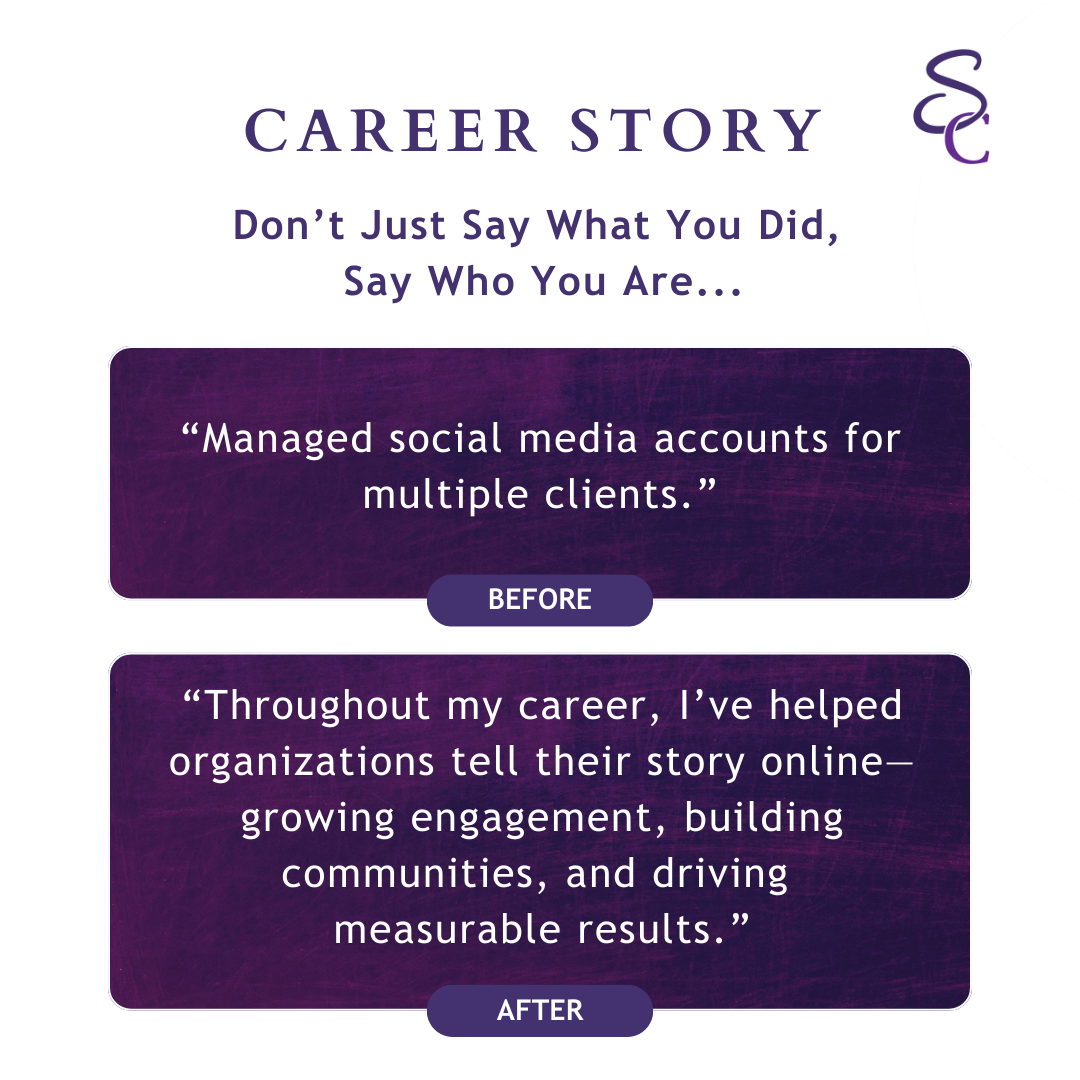
See the difference? The second version doesn’t just say what you did, it says who you are.
Career Story Templates
Here are three fill-in-the-blank templates to help you craft your own narrative:
- The “Connector” Story
I’ve always been drawn to [big theme: solving problems, connecting people, organizing chaos]. In my role at [Company/Title], I [key achievement]. That experience led me to [next role or pivot], where I expanded my skills in [skill/impact]. Today, I bring [unique strengths] and am excited to apply them to [future goal/desired role].
- The “Pivot with Purpose” Story
My career began in [original field/industry], where I learned [skills/strengths]. Over time, I realized my passion for [new focus], which led me to [pivot role or training]. Since then, I’ve [key wins in new direction]. Now, I’m looking to leverage both my [original field strengths] and [new focus] to make an impact as [desired role].
- The “Builder” Story
Throughout my career, I’ve focused on building [teams, systems, programs, communities]. At [Company/Role], I [specific accomplishment with measurable impact]. I carried that experience into [next role], where I [impact]. Looking ahead, I want to continue building [what you want to create next] as a [future role/goal].
Write your version of one of these templates, then practice saying it out loud. You’ll be amazed at how much more confident and compelling you sound in interviews and networking conversations.
Ready to Tell Your Story?
Your career story is already there; you just need to uncover it. If you’re struggling to connect the dots or put it into words, I can help:
- Download the Resume Tip Sheet (and join our email list for more guidance).
- Dive deeper with the Resume Workbook to build your own narrative.
- Or book a 30-Minute Resume Review for one-on-one coaching to bring your story to life.
Your next opportunity isn’t just about your skills. It’s about your story. And the clearer your story, the easier it is to choose the right path forward.